
Key Takeaways
- 93% of potential customers research across multiple platforms before deciding who to buy from — meaning a single-channel strategy misses most of the buying journey.
- Moving from one to six marketing platforms can push ROI from 0% up to 7.5%, and retailers on three or more channels generate over 140% more revenue than those on fewer channels.
- Customers average 11 touchpoints with a brand before making a purchase — consistent cross-channel presence is what keeps a business in the running.
- Fredette Creative Media’s MultiCasting approach is built around distributing content in eight formats across 300+ platforms each month — a systematic answer to the modern research-before-buying reality.
- Keep reading to see the real-business revenue results that organic, multi-platform content strategies have produced — including one company that went from $48k to $735k in monthly sales in just 12 months.
The way customers find and choose businesses has changed completely. They no longer just search Google once and pick the top result. Before spending a single dollar, today’s buyer is watching YouTube videos, reading Facebook posts, asking ChatGPT, listening to podcasts, and scrolling through TikTok — all while mentally deciding who they trust. If a business only shows up in one of those places, it’s practically invisible to the other 73% of that discovery journey.
Online Reviews and Multi-Channel Research Drive Purchase Decisions
Before a customer ever calls, clicks, or walks through a door, they’ve already done their homework. A striking 93% of people research across multiple platforms before deciding who to do business with. That number alone rewrites the rulebook for how businesses need to think about their marketing.
It’s not just online-first purchases either. A full 86% of shoppers research products online even when they intend to buy in-store. This means that multi-channel visibility isn’t a luxury for e-commerce brands — it’s a baseline requirement for any business that wants to be found, trusted, and chosen. The research phase is now the decision phase, and it’s happening across search engines, social media, video platforms, AI tools, and podcasts simultaneously.
What makes this especially significant is how buyers use these platforms together. They’re not visiting one platform and deciding — they’re building a picture of a brand piece by piece, across multiple interactions. The businesses that show up consistently across those interactions are the ones that earn trust. The ones that don’t quietly lose ground to competitors who do. This is the core insight behind the MultiCasting strategy developed by Fredette Creative Media / Creative Flow — a content distribution system built specifically to meet buyers wherever they’re looking.
Single-Channel Marketing Is Losing the Game
There was a time when ranking on Google was enough. A solid SEO strategy, a well-optimized website, and a Google Business Profile could reliably fill a pipeline. That era hasn’t disappeared entirely — but it’s no longer the whole game.
Search Engines Are Just One Piece: 27% of Daily Research Happens There
According to data from Fredette Creative Media / Creative Flow, Google Search and traditional search engines account for only 27% of daily research activity. That’s a significant slice — but it leaves nearly three-quarters of discovery happening somewhere else entirely. Businesses that pour their entire budget into search engine visibility are effectively competing hard for a minority of their potential audience while ignoring the majority.
This doesn’t mean search engines don’t matter. They absolutely do. But treating them as the only channel is like opening one door in a building that has ten entrances. Competitors who have content on YouTube, in podcast directories, on social feeds, and inside AI recommendation engines are covering the full building — and getting traffic from every direction.
YouTube, Social, AI, and Podcasts Are Where the Rest of Your Buyers Are
The remaining 73% of daily research activity takes place across what might be called modern discovery platforms: YouTube, TikTok, Instagram, Facebook, LinkedIn, Spotify, Apple Podcasts, and AI tools like ChatGPT, Claude, and Perplexity. These aren’t fringe channels for specific demographics — they represent the broad majority of how people across age groups are now discovering, evaluating, and vetting businesses.
AI tools in particular are a fast-growing factor. When someone asks ChatGPT which epoxy flooring companies are most trusted near them, or which medical device brands have the best reputation, the AI pulls from indexed content across the web. Businesses with content living on authority sites, news platforms, and video channels are far more likely to appear in those recommendations than businesses with only a website and a few search ads. Research behavior has shifted — and marketing strategy has to shift with it.
The ROI Numbers Behind Multi-Platform Campaigns
Saying multi-platform marketing works is one thing. Showing exactly how the numbers move as more channels are added is another. The data here is compelling — and specific.
1. Two Platforms Unlocks 4.1% ROI; Six Platforms Reaches 7.5%
Moving from a single marketing platform to just two boosts measurable ROI from 0% to 4.1%. That jump alone justifies expanding beyond a single channel. But the gains don’t stop there — adding platforms progressively increases ROI, reaching 7.5% at six platforms. Notably, diminishing returns begin to set in beyond the sixth channel, which suggests that smart multi-channel marketers focus on strategic platform coverage rather than spreading thin across every possible network.
The key insight here isn’t just that more platforms equal more ROI — it’s that every additional channel creates new entry points into the customer’s awareness. Each platform where a brand has a presence is another opportunity to be discovered, recognized, and remembered.
2. Omnichannel Shoppers Deliver 30% Higher Lifetime ROI
Customers who discover and interact with a brand across multiple channels don’t just convert more easily — they’re worth more over time. Omnichannel shoppers deliver a 30% higher lifetime return on investment than customers who came through a single channel. This makes intuitive sense: a customer who has seen a brand on YouTube, read a blog post, heard a podcast mention, and then found the business on Google has a much stronger brand connection than someone who clicked one ad.
That stronger connection translates directly into longer relationships, higher average order values, and more word-of-mouth referrals — all of which compound over time. In terms of long-term ROI, multi-platform marketing isn’t just better — it’s structurally superior.
3. Three or More Channels Generates Over 140% More Revenue
Retailers who sell and market on three or more channels generate over 140% more revenue than those who stick to fewer channels. This statistic is particularly striking because the jump isn’t marginal — it’s transformational. A business doing $200k a year on a single channel could theoretically be doing close to $500k with the same underlying product by simply showing up in more places.
Forrester Research has also found that companies using a multi-channel approach achieve higher conversion rates than those relying on a single channel — a finding that aligns with what the revenue data shows. More channels mean more touchpoints, which means more conversions at every stage of the buyer journey.
11 Touchpoints: How Customers Actually Find You
On average, a shopper engages with a brand at 11 different touchpoints before making a purchase. Eleven. That’s not eleven visits to the same website — it’s eleven distinct interactions across different formats and platforms. A blog post here, a YouTube video there, a podcast mention, a social share, a Google Maps listing, an AI recommendation. Each one adds a layer of familiarity and trust.
Brand Recall Rises With Cross-Channel Exposure
Multi-platform campaigns don’t just reach more people — they make a brand stick. Research has shown that multi-platform campaigns can meaningfully boost brand recall. That’s not a small bump. In a market where buyers are evaluating multiple options simultaneously, being the brand they actually remember at the moment of decision can be the entire difference between winning and losing the sale.
Brand recall isn’t built through a single brilliant ad — it’s built through repeated, consistent exposure across different environments. When someone sees a business mentioned in a news article, then hears it referenced in a podcast, then spots a short-form video explaining a topic they care about, the brand becomes familiar. Familiarity breeds trust. Trust drives purchasing decisions.
Cross-Channel Presence Drives Loyalty, Not Just Clicks
Research confirms that cross-channel integration positively influences customer satisfaction, engagement, word of mouth, perceived fluidity, and loyalty. These aren’t soft, hard-to-measure outcomes — they feed directly into repeat business, referrals, and lower customer acquisition costs over time. A customer who experiences a brand across multiple channels feels like they know the business, even before their first direct interaction.
This is why multi-channel marketing isn’t just a lead generation play — it’s a full-funnel business development strategy. It builds the kind of brand equity that paid ads can’t replicate, because ads stop the moment the budget runs out. Cross-channel content presence compounds.
What MultiCasting Does Differently
Most businesses understand, at least in principle, that they should be showing up in more places online. The challenge is execution. Creating quality content in multiple formats, optimized for different platforms, and distributing it consistently every month is a significant operational undertaking — one that most small and medium businesses don’t have the internal capacity to sustain.
Eight Content Formats Across 300+ Platforms Each Month (Per Provider Claims)
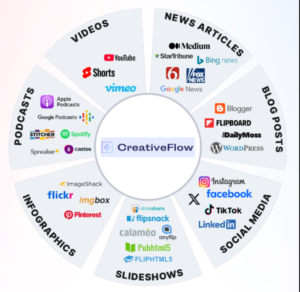
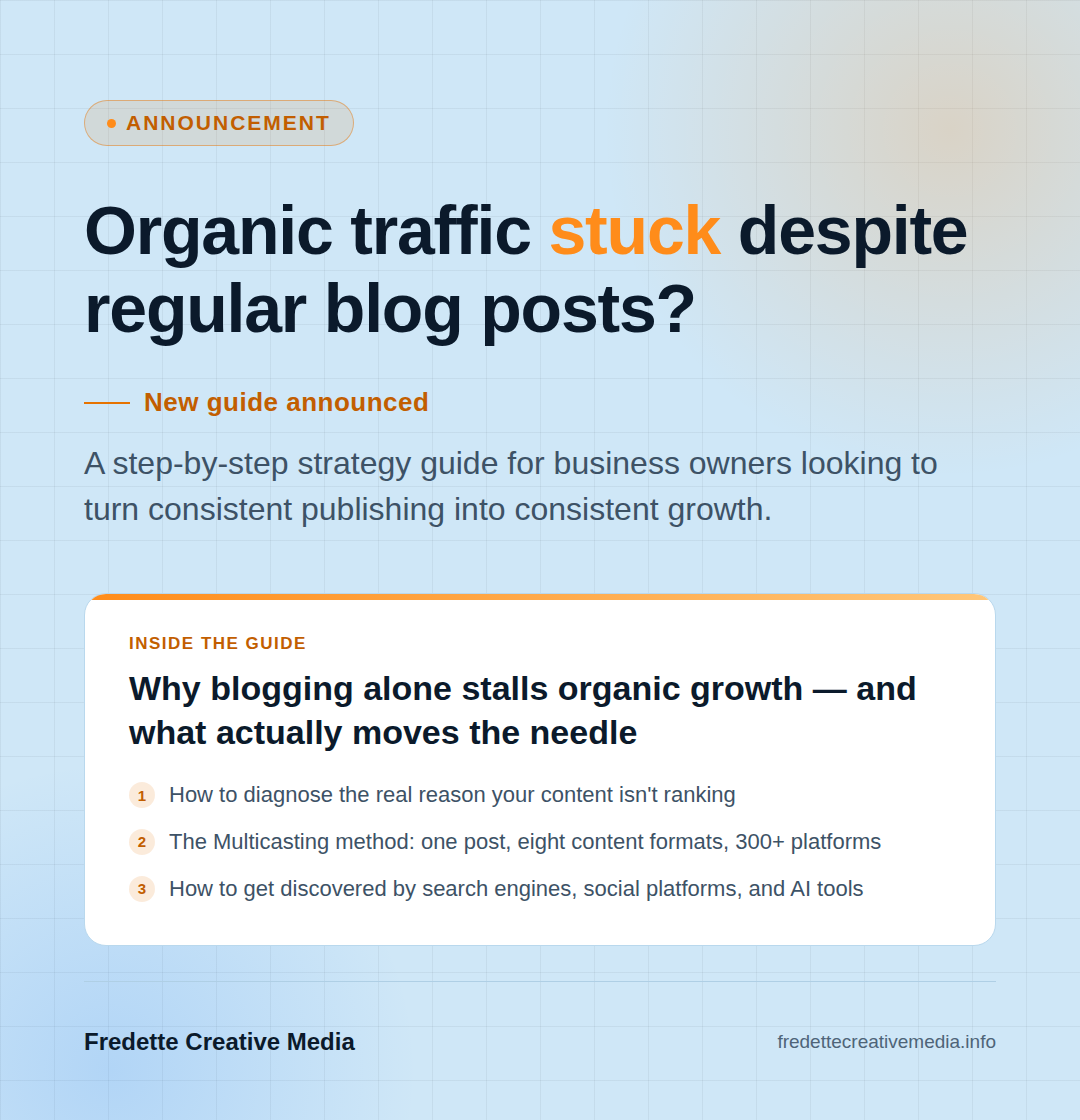
Fredette Creative Media / Creative Flow’s MultiCasting approach is built around producing content in eight specific formats every month: news articles, social posts, Reels and Shorts, infographics, interview podcasts, flipbooks and slideshows, blog posts, and longer informational videos. Each format serves a distinct purpose — news articles build authority, short-form videos capture attention on TikTok and Instagram, podcasts reach listeners on Spotify and Apple Podcasts, and infographics perform on Pinterest and in visual searches.
According to the company, this content is then distributed to 300+ platforms, including search engines, social media networks, video platforms, podcast directories, AI tools, news sites, authority blogs, and Q&A sites. The logic is straightforward: the more places a business’s content lives, the more likely it is to show up wherever a potential buyer is doing their research — which, as the data shows, could be almost anywhere.
Content Optimized Per Platform — Not Just Repasted
The distinction that separates MultiCasting from simply recycling one piece of content is optimization. Copying and pasting the same text everywhere doesn’t work — and can actually hurt performance. Each platform has its own algorithm, audience behavior, and content expectations. A LinkedIn post that performs well looks and reads nothing like a TikTok script. A podcast introduction has different requirements than an infographic caption.
Fredette Creative Media describes the MultiCasting process as carefully repurposing content across all formats, optimized specifically for each platform. This format-specific approach is what allows the content to be discovered by platform algorithms and recommended to audiences — rather than simply existing on the internet without traction. That’s the difference between a content strategy that compounds over time and one that produces little measurable impact.
Real Results: Traffic, Sales, and Zero Ad Spend
Statistics and frameworks are useful — but what actually happened when real businesses applied this kind of multi-platform, organic content strategy? The case results from Fredette Creative Media / Creative Flow tell a clear story.
Medical Device Company: $48k to $735k Monthly in 12 Months
A medical device company using the MultiCasting approach saw its monthly sales grow from $48,000 to $735,000 in just 12 months — a 20,000% traffic increase and an annual revenue increase of $8.3 million. This is the kind of result that reframes the entire conversation around marketing investment. No paid ad campaign can produce compounding organic growth at that scale, because the moment ad spend stops, traffic stops. Organic, multi-platform content keeps working.
The mechanism behind this growth is the same one the channel research data points to: when a brand starts showing up everywhere potential buyers are looking — in search, in video, in podcasts, in news — the cumulative effect multiplies. Each new piece of content adds to the traffic-generating footprint of the business, and that footprint grows month over month.
Epoxy Flooring: $1.6M in Sales, Pure Organic Traffic
An epoxy flooring business generated $1.6 million in sales over 12 months with zero ad spend — driven entirely by organic, multi-platform content. No Google Ads budget. No paid social. Just strategic content placed in the right formats, on the right platforms, answering the questions that buyers were already asking across channels.
This result highlights something significant for small and medium businesses stuck in the cycle of increasing ad spend just to maintain flat results: the alternative isn’t to advertise more creatively — it’s to build a content presence that doesn’t require a continuous payment to keep producing leads. Organic multi-channel content is a long-term asset, not a recurring expense.
Show Up Everywhere or Lose to Competitors Who Do
The data tells a consistent story. Buyers research across channels before they buy — all 93% of them. They average 11 touchpoints before making a decision. Adding platforms multiplies ROI. Omnichannel customers are worth 30% more over their lifetime. Businesses on three or more channels generate over 140% more revenue. Every one of these findings points to the same conclusion: multi-platform presence is no longer a nice-to-have — it’s the minimum viable strategy for competing in today’s market.
The businesses that are growing fastest right now aren’t necessarily the ones with the biggest ad budgets. They’re the ones that figured out how to show up consistently across the full range of platforms where their buyers are spending time. A potential customer who discovers a business on a podcast, looks them up on YouTube, finds a news article about them, and then sees their social posts has already built a relationship before the first conversation. That’s the power of cross-channel presence — and it’s entirely achievable without pouring money into pay-per-click ads that disappear the moment the billing cycle ends.
The 2026 traffic landscape has shifted fundamentally. Search is just one door. Buyers are coming through many. The businesses that open all of those doors — with quality, optimized, platform-specific content — are the ones that win the long game. Multi-channel marketing isn’t about complexity for its own sake. It’s about meeting buyers where they already are, and doing it consistently enough that when the moment to buy arrives, there’s only one name they remember.
Fredette Creative Media / Creative Flow specializes in helping small and medium businesses build exactly that kind of compounding, multi-platform presence — driving qualified traffic and real sales growth without relying on ad spend.
Company: Fredette Creative Media / Creative Flow City: Cincinnati Address: 2983 Twilight Drive Website: https://www.fredettecreativemedia.info Email: 123CreativeFlow@gmail.com>