Capture 73% More Buyers With One Insight, Eight Formats, and 300+ Platforms
SEO has evolved into modern-day multicasting. A single core insight, repurposed across eight content formats and distributed across 300+ platforms, now drives more organic visibility than any single-channel strategy.
The old playbook – write a blog post, target a keyword, wait for Google to rank it – no longer works alone. Today, 93% of buyers research across multiple platforms before making a decision. Only 27% of that research happens on traditional Google search. The remaining 73% happens on YouTube, social media, AI tools, podcasts, and visual search platforms.
If your strategy still revolves around one channel, you’re invisible to nearly three-quarters of your potential audience at the moment they’re making purchasing decisions.
Quick Takeaways: What Makes a Multicasting Campaign Work
- One insight, eight formats: A single piece of research becomes a blog post, video, podcast, social post, reel, infographic, news article, and slideshow.
- Platform-native optimization: Each format is adapted to the algorithm and audience expectations of its destination platform.
- Compounding visibility: Traffic generates more traffic as algorithms reward consistent, multi-format presence with greater distribution.
- AI citation readiness: Structured, multi-format content increases the likelihood of being cited in AI-generated answers.
- Brand search growth: Showing up everywhere builds the branded search demand that Google now treats as a core trust signal.
Why Old SEO Strategies Fall Short
For years, SEO followed a linear path: research keywords, write content, build backlinks, optimize technical elements, climb the rankings. Those fundamentals still matter. Keywords, backlinks, page speed, and clear site architecture remain the backbone of any winning strategy. But the context has shifted.
AI Overviews now sit at the top of Google’s results page, reducing click-through rates on informational queries. Users who do click through are more qualified, but raw traffic volumes have declined for many sites. Meanwhile, your audience has fragmented across a dozen or more platforms where they conduct genuine research with real purchase intent.
The marketers winning right now haven’t abandoned SEO. They’ve expanded their definition of it. The goal is no longer to rank on Google alone. The goal is to show up wherever your audience searches.
The Numbers Behind the Shift
27% of daily research happens on traditional Google search. 73% happens across YouTube, social platforms, AI tools, and podcasts. If your entire organic strategy is built around Google’s blue links, you’re competing for less than a third of your audience’s attention.
This is the reality right now. Buyers ask deeper questions across search, social, video, podcasts, and AI. They want product demonstrations on YouTube, real opinions on Reddit, comparison content on TikTok, and synthesized answers from ChatGPT and Perplexity. Presence on a single platform no longer cuts it.

What Is Multicasting?
Multicasting is the deliberate process of taking one core insight, repurposing it into multiple content formats, and distributing those formats across every platform where your audience has search intent. Each piece is carefully adapted to fit the format, algorithm, and audience expectations of its destination.
Think of it like a broadcast network. A television network doesn’t create entirely new content for every channel it owns. It produces a core piece of programming, then distributes clips, highlights, interviews, behind-the-scenes content, and social posts across its ecosystem. Each piece is native to its platform but traces back to the same central insight.
This works because algorithms on every platform reward consistency, relevance, and engagement. When you publish high-quality content in multiple formats across multiple platforms, you create a self-feeding growth cycle where visibility compounds over time.
Why Multicasting Outperforms Single-Channel SEO
The compounding effect makes multicasting powerful. A single well-optimized YouTube video can simultaneously rank on YouTube, appear in Google’s video carousel, get embedded into AI-generated answers, and support the rankings of your written blog content when placed on-page. That’s four visibility surfaces from one piece of content.
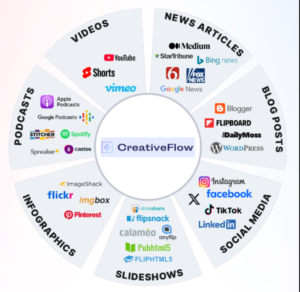
Now multiply that across eight formats and 300+ platforms. Each format captures intent on a different platform from a single research and production effort. The same core insight about a product comparison can power a 2,000-word pillar page, a 10-minute YouTube tutorial, a LinkedIn carousel, a TikTok reel, a podcast interview, an infographic, a news article, and a slideshow.
The Anatomy of a Multicasting Campaign: One Insight, Eight Formats
The process starts with one core insight: a piece of research, a unique perspective, a product demonstration, or an answer to a high-intent question. From that single insight, you create eight content formats, each optimized for its destination platform.
1. Blog Posts for SEO and Website Content
The foundation. A well-structured blog post targets specific search intent, incorporates relevant keywords naturally, and serves as the hub that other formats link back to. Build topical authority through pillar pages and content clusters. Embed your YouTube video, link to your podcast episode, and reference your social content to create an interconnected content ecosystem.
2. Longer Informational Videos for YouTube
YouTube is a primary SEO surface. Google actively integrates YouTube videos into results pages, AI Overviews, and featured snippets. Treat your video script with the same keyword intent discipline as a blog post. Use natural language, answer specific questions out loud, and structure the video around a clear topic. Google indexes video transcripts, so spoken words function like written content.
3. Reels and Shorts for TikTok, Instagram, and YouTube Shorts
Short-form video captures discovery intent for younger demographics searching product recommendations. Extract the most compelling 30-60 seconds from your longer video: a key statistic, a surprising insight, a quick demonstration. Optimize with platform-native captions, trending audio where appropriate, and clear on-screen text that communicates value without sound.
4. Social Posts for Facebook, Instagram, LinkedIn, and X
Each platform has its own format expectations. LinkedIn favors thought leadership carousels and text posts with depth. Instagram rewards visual consistency and storytelling. Facebook and X suit conversation-starting takes that drive engagement. Adapt your core insight to each platform’s language rather than cross-posting identical content.
5. Interview Podcasts for Spotify, Apple, and Google Podcasts
Podcasts are increasingly indexed and surfaced for informational searches. An interview format generates experiential depth, personal anecdotes, and authentic expertise – all signals that Google’s Helpful Content system rewards. Publish on all major podcast directories to maximize discoverability.
6. Infographics for Pinterest and Visual Search
Visual search is growing fast, especially for product discovery and how-to queries. Infographics distill complex information into a shareable visual format that performs on Pinterest, gets picked up by blogs, and can appear in Google’s image results. Use high-quality original images, descriptive alt text, and structured data markup.
7. News Articles for Authority and Google News
Press releases and news-style articles build brand authority and get indexed by Google News. This format is effective for product launches, company milestones, industry commentary, and data-driven insights. Distribution to authoritative news sites builds the entity clarity and brand mentions that feed into AI-generated search results.
8. Flipbooks and Slideshows for SlideShare and Document Platforms
Document-sharing platforms like SlideShare carry genuine discovery intent, especially for B2B audiences researching solutions. A flipbook or slideshow repurposes your blog post’s key points into a visual, scannable format that’s easy to consume and share. These platforms also generate backlinks and brand mentions that strengthen your overall SEO profile.
How to Distribute Across 300+ Platforms Without Spreading Too Thin
The biggest mistake marketers make with multicasting is trying to be everywhere at once. That leads to mediocre content on six platforms instead of excellent content on two. The smarter approach: audit where your specific audience already has search intent, build depth on those channels first, then expand.
Multicasting doesn’t mean manually posting to 300 platforms yourself. It means using efficient processes and specialist tools to distribute adapted content at scale. The eight formats above can be published across search engines (Google, Bing, Yahoo, and 50+ more), social media platforms, video platforms, podcast directories, AI tools (ChatGPT, Perplexity, Claude), news sites, authority blogs, and Q&A sites.
The Self-Feeding Growth Cycle
When you multicast effectively, your content generates visibility, which generates clicks, which generates traffic, which generates leads and reviews, which generates more visibility. Algorithms see the engagement and show your content to more people. Your brand starts appearing in AI-generated answers because your content is structured, authoritative, and distributed across multiple trusted sources.
This compounding asset grows over time. Unlike paid ads – which stop the moment you stop funding them – multicasted content continues to generate returns month after month.
Building Branded Search Demand Through Multicasting
One of the most significant shifts in 2026: branded search demand has become a core ranking signal. When real people actively search for your brand name, it tells Google your brand has genuine recognition and authority. This signal is very difficult to fake, and multicasting builds it organically.
Every time your content appears on a new platform, a new audience encounters your brand. Some will search for you directly later. Those branded searches accumulate, signaling to Google that your brand matters. Sites with growing branded search volume consistently show stronger ranking stability, even when non-branded keyword positions fluctuate.
Practical Tactics to Grow Branded Search
- Run awareness campaigns that put your brand name in front of cold audiences consistently across multiple formats.
- Build a recognizable point of view through thought leadership content on LinkedIn, YouTube, and industry publications.
- Encourage reviews and mentions on platforms like Reddit, G2, and Trustpilot – all of which feed into AI-generated search results.
- Create branded content series with a consistent name that audiences search for directly.
- Use PR and digital outreach to earn mentions on authoritative domains that establish entity clarity.
Measuring Multicasting Success: Beyond Traditional SEO Metrics
If you’re still measuring SEO purely by keyword rankings and raw organic traffic, you’ll undervalue what multicasting delivers. Track branded search volume growth, AI citation frequency, content engagement quality across platforms, and assisted conversions alongside traditional ranking data.
Traffic from multicasting tends to carry higher intent. Users have already encountered your brand on multiple platforms. They’ve seen your YouTube video, read your Reddit thread, and noticed your infographic on Pinterest. By the time they reach your website, they already trust you, understand your offer, and are ready to act.
A medical device company using multicasting strategies saw a 20,000% traffic increase in 12 months, growing from $48k/month to $735k/month in sales. An epoxy flooring business generated $1.6M in sales over 12 months with zero ad spend – pure organic traffic from multicasted content. These results happen when you align your strategy with how modern buyers actually search.
FAQ: Multicasting and the Future of Organic Search
Is multicasting just another word for content repurposing?
No. Content repurposing is part of multicasting, but multicasting goes further. It involves strategic platform-native optimization, systematic distribution across 300+ platforms, and a focus on building algorithmic momentum across every surface where your audience searches. Repurposing is tactical; multicasting is strategic.
Do I still need traditional SEO if I’m multicasting?
Yes. Keywords, backlinks, technical optimization, page speed, and clear site architecture remain the foundation. Multicasting expands your SEO strategy; it doesn’t replace it. Think of traditional SEO as the foundation and multicasting as the structure built on top.
How often should I publish multicasted content?
Consistency matters more than volume. A monthly multicasting campaign that produces eight formats from one insight and distributes them across 300+ platforms will outperform sporadic publishing on a single channel. Regular, systematic output gives algorithms fresh content to index and distribute.
Can small businesses benefit from multicasting?
Small businesses often see the most dramatic results because they’re competing against larger brands that are slow to adapt. A local business that publishes eight content formats across multiple platforms can dominate local search results, Google Maps rankings, and AI-generated recommendations in their area – often faster than competitors relying on traditional SEO alone.
The Strategic Shift You Can’t Afford to Delay
The brands that recognize this shift and adapt are building compounding organic assets that deliver traffic and sales for years. The brands that don’t are competing for a shrinking share of attention on a single platform while their competitors show up everywhere.
The anatomy of a multicasting campaign is straightforward: one core insight, eight content formats, 300+ distribution platforms, and a commitment to consistent execution. The process is efficient, the pricing is realistic through specialists, and the results are measurable.
Start by auditing where your audience already searches. Identify the platforms with genuine discovery intent for your industry. Then build your first multicasting campaign around a single high-value insight. The compounding effect starts with the first piece of content you distribute.