
In 2026, ranking on Google alone won’t grow your brand. Your buyers split their attention across YouTube, TikTok, AI tools, podcasts, Reddit, and news sites before they ever contact you.
SEO has become multicasting: one core insight, broadcast across every platform your audience uses.
Quick Takeaways
- Multicasting vs. old-school SEO: Traditional SEO targets Google’s blue links. Multicasting puts your brand on YouTube, TikTok, AI platforms, and news sites at the same time.
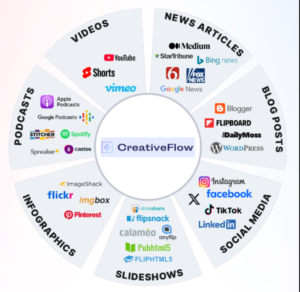
- The 8-Format Rule: One piece of expertise becomes a news article, social post, reel, infographic, podcast, flipbook, blog post, and long-form video.
- Buyer behavior: 93% of consumers research across multiple platforms before buying. A single-channel approach misses 73% of the market.
- Branded search matters: Branded search demand is now a primary ranking signal. Reputation management carries as much weight as technical optimization.
Why Multicasting Replaces Single-Channel SEO
For decades, the goal was simple: rank on page one of Google. In 2026, that goal is too narrow. Buyers ask ChatGPT for recommendations. They search TikTok for product reviews. They use Google Lens to identify items in real life.
The data confirms it. Google search accounts for roughly 27% of daily research in some sectors. The other 73% happens on YouTube, social media, podcasts, and AI tools. If your content only lives as a blog post, you’re missing most of the buyer’s path.
Multicasting fixes that. Whether a customer browses Reddit or listens to a podcast, your brand shows up with authority.
The “Blue Link” Monopoly Is Fading
AI Overviews and zero-click searches have cut traditional organic click-through rates. Brands that only rely on their website will fall behind.
When your content appears on news sites, YouTube, and AI platforms, it sends a strong signal to Google: your brand is trustworthy. That signal feeds back into better organic rankings. A self-reinforcing cycle.
The 8 Formats That Build Authority in 2026
One piece of expertise. Eight distinct formats. Each one serves a different segment of the search ecosystem.
1. News Articles
Publishing on news platforms and authority sites builds instant credibility. A feature in Google News or a major industry publication is a powerful trust signal for E-E-A-T.
2. Social Posts
LinkedIn, X, and Facebook are indexed by search engines. They serve as primary tools for B2B and B2C audiences. Summarize key insights and drive engagement signals back to your brand.
3. Reels and Shorts
Short-form video on TikTok, Instagram, and YouTube Shorts is how younger audiences search for answers. These quick visual clips answer specific questions and often appear in Google’s mobile results.
4. Infographics
Visual search through Google Lens and Pinterest is growing fast. Strong infographics let your data reach users who search for visual breakdowns of complex topics.
5. Interview Podcasts
Audio content is indexed more deeply than ever. Hosting or guesting on podcasts distributed through Spotify and Apple Podcasts captures the “passive searcher” – someone who wants deep expertise while multitasking.
6. Flipbooks and Slideshows
Platforms like SlideShare still attract high-intent B2B professionals. A well-structured slideshow or flipbook captures people who search for frameworks and data.
7. Deep Blog Posts
The blog post remains the pillar of your strategy. It gives search engine crawlers the technical depth and keyword structure they need to understand your topical authority.
8. Long-Form Video
YouTube is the world’s second-largest search engine. Long-form video demonstrates expertise and feeds Google’s video carousels and AI Overviews.
Scaling to 300+ Platforms Without Burnout
The biggest objection to multicasting: workload. How does a small team manage 300+ platforms?
You don’t create 300 pieces of content. You create one high-value “Expertise Asset” and use a systematic process to break it into platform-specific formats.
Synchronized Distribution
Move from manual posting to an automated, specialist-driven workflow. A standardized framework lets you publish across search engines, social media, video platforms, podcast directories, and AI tools (ChatGPT, Perplexity) at the same time. Your brand’s footprint grows while your team stays focused on the core business.
Avoid the “Spread Too Thin” Trap
Prioritize the platforms where your specific audience lives. Audit where your target demographic has the highest search intent. For many brands, that means going deep on YouTube and Reddit before expanding elsewhere. Depth on three channels beats a thin presence on ten.
Multicasting vs. Generic AI Content
Flooding the web with generic AI-generated content won’t produce multicasting results. Google’s Helpful Content systems are sophisticated enough to identify and downrank commodity content that lacks human insight.
“Search in 2026 rewards brands that truly understand their audience. The real wins come from listening to customers and creating quality content that reflects their needs.”
The technical difference: Expertise Integration. Multicasting uses AI for efficiency – outlining, formatting, fragmenting. The core insights come from a subject matter expert. To rank for competitive terms, your content needs first-person experience, original data, or a point of view that an LLM cannot replicate.
Platform-Specific Algorithms Matter
A generic AI summary won’t perform the same on TikTok as it does on LinkedIn. Each platform has its own language. Multicasting means adjusting the delivery to fit each channel’s algorithm. A YouTube transcript needs spoken keywords Google can index. A news release needs formal journalistic tone to pass editorial standards.
Measuring Success
When you shift to multicasting, your KPIs shift too. Raw organic traffic to your website is only part of the picture. Track these:
- Branded Search Volume: Are more people searching for your brand by name in Google Search Console?
- AI Citation Frequency: How often does your brand get cited in Perplexity or ChatGPT answers?
- Multi-Channel Attribution: Do leads say they “saw you everywhere” before reaching out?
- Google Maps Presence: Does your multicasting effort (news and citations) correlate with higher local rankings?
FAQs
Is traditional SEO dead in 2026?
No. Technical SEO, keywords, and backlinks are still the foundation. They’re just no longer the entire structure. You must now optimize for “Search Everywhere,” not only Google.
How does multicasting help with AI Overviews?
AI models like Gemini and ChatGPT pull from many sources. When your content exists in multiple formats (news, video, PDF, blog), you raise the probability that an AI cites your brand as the definitive answer.
Can I use AI in the multicasting process?
Yes. AI excels at the fragmentation phase: turning a long-form transcript into social posts or a podcast outline. The original expertise must be human-led to meet Google’s E-E-A-T standards.
What format should I start with?
For most businesses, video (YouTube specifically) offers the highest return. A single video can become a blog post, a podcast, several reels, and social updates with minimal extra effort.
Build Compounding Visibility
The brands winning search in 2026 have accepted a simple truth: one post on one platform is no longer enough. Multicasting creates a self-sustaining system where every piece of content reinforces the next. This builds a long-term, compounding asset that makes your brand the obvious choice wherever customers search.
Your Next Step: Audit your current content. Take your best-performing blog post from the last year. Is it a video? A podcast? On a news site? If not, you’re sitting on untapped authority. Turn that one insight into eight formats today.