
SEO has become multicasting. Your audience searches across YouTube, TikTok, Reddit, AI platforms, and podcast directories before they ever buy. A single blog post on Google no longer cuts it.
Here’s the trap: most marketers sign up for every platform, post mediocre content on six of them, and burn out in three months.
The winning approach is precision.
Audit where your audience actually searches. Go deep on two or three platforms. Repurpose one core idea into eight formats. You build a multicasting system that drives traffic without draining your team.
This guide shows you how.
Quick Takeaways
- Focus beats breadth. Posting on every platform without a plan leads to forgettable content everywhere. Audit your audience first.
- Use tools like SparkToro to identify where your ideal customers search, then go deep on those platforms.
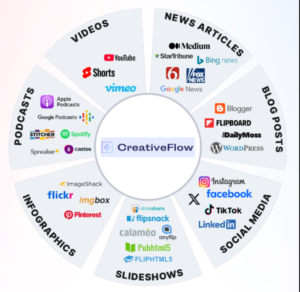
- Repurpose one core idea into eight formats: blog, video, reel, podcast, infographic, social post, news article, and slideshow.
- Distribute to 300+ platforms using a systematic process, not manual posting.
- Real results: One company saw a 20,000% traffic increase and $8.3 million in annual sales from disciplined multicasting.
Why SEO Has Become Multicasting
Organic search results no longer live inside Google’s blue links. In 2026, 93% of buyers research across multiple platforms before purchasing, according to Creative Flow research. They search Google, watch YouTube reviews, check Reddit threads, ask ChatGPT, and browse TikTok for product demos.
If your brand shows up on one channel, you’re invisible during 73% of those moments.
Multicasting means creating content in multiple formats and distributing it across every platform where your audience searches. You adapt the message to each platform’s native format while keeping a consistent brand voice. The goal: show up wherever your customer asks a question, so you earn the click before your competitor does.
The Biggest Mistake: Spreading Too Thin
When marketers first hear about multicasting, the instinct is to sign up for everything and start posting. That’s the fastest path to burnout and weak results.
The biggest mistake is trying to be everywhere at once, producing average content on six platforms instead of excellent content on two.
The Cost of Average Content on Every Platform
Algorithms reward consistency and depth. A TikTok account posting three times a week with high-quality, on-trend videos will outperform a brand posting once a week with generic clips. The same applies to YouTube, LinkedIn, and podcasts.
When you spread thin, you never build the momentum needed to earn organic reach. Worse, your content becomes forgettable because it lacks the specific insight or personality that makes people stop scrolling.
Why Focus Wins
Focus builds topical authority. Google, YouTube, and AI platforms all favor brands that demonstrate deep expertise in a niche.
By concentrating on two or three platforms, you create a content library that tells a complete story. A B2B SaaS company might focus on YouTube (long-form tutorials), LinkedIn (thought leadership carousels), and a blog (SEO-optimized guides). Each platform reinforces the others, creating a compounding effect that drives organic search results across all channels.
How to Find Where Your Audience Actually Searches
Before you create a single piece of content, you need to know which platforms your target audience uses. Guessing leads to wasted effort. Use data to uncover intent.
Use SparkToro to Audit Platform Preferences
SparkToro analyzes millions of social profiles and web data to show you where your audience spends time. Enter a keyword related to your niche, and it reveals the percentage of your audience on YouTube, Reddit, Twitter, TikTok, Pinterest, and more. It also shows the podcasts they listen to and the influencers they follow.
This data kills guesswork.
A local roofing company might find that their audience searches primarily on Google (for emergency services) and YouTube (for how-to videos). They don’t need TikTok or Instagram. Focus on Google Maps optimization and YouTube tutorials; that’s where the search intent lives.
Audit Search Intent by Platform
Each platform serves a different type of search intent:
- Google: Informational and transactional queries. People want answers or want to buy.
- YouTube: How-to, reviews, and demonstrations. Users want to see the product in action.
- Reddit: Opinion-based and experiential queries. Users want honest peer reviews.
- TikTok/Instagram: Inspiration and browsing. Users scroll for ideas, not with high purchase intent.
- AI platforms (ChatGPT, Perplexity): Summarized answers. Users want concise, authoritative information.
Match your content format to the dominant intent on each platform. If you push a transactional blog post onto TikTok, it won’t work. Instead, repurpose that blog post into a short, engaging video that sparks curiosity.
The 8-Format Repurposing Model
One of the most efficient ways to multicast without burning out: create one core piece of content, a pillar page or a thorough video, and repurpose it into eight formats.
The Eight Formats
- News Article – For authority and Google News. Write a press release or industry commentary based on your core topic.
- Social Posts – Short, scannable updates for Facebook, Instagram, LinkedIn, X. Pull key quotes or statistics.
- Reels/Shorts – Vertical video for TikTok, Instagram Reels, and YouTube Shorts. Focus on one actionable tip.
- Infographic – Visual summary for Pinterest, SlideShare, and image search. Use tools like Canva.
- Interview Podcast – Expand the core idea into a conversation. Publish on Spotify, Apple Podcasts, Google Podcasts.
- Flipbook/Slideshow – Presentation-style format for SlideShare and document sharing sites. Strong for lead generation.
- Blog Post – The SEO-optimized foundation. This is your anchor.
- Long-Form Video – YouTube or Vimeo. Record a tutorial or thorough walkthrough based on the blog post.
How to Repurpose Without Starting from Scratch
Start with a high-quality blog post (1,500 to 2,000 words). Use the blog post as a script to record a 10-minute YouTube video. Extract the best 60-second tip for a Reel or Short. Turn the key statistics into an infographic. Write a news-style press release about the topic. Record a 20-minute podcast episode with a colleague discussing the post. Create a LinkedIn carousel with the top five takeaways. Compile the slides into a PDF for SlideShare.
This workflow takes one day of focused creation, but the output lasts for weeks. Distribute each format to its platform cluster, and you have a multicasting system that feels like a full-time team but runs on one person’s effort.
How to Distribute to 300+ Platforms Efficiently
Publishing to 300+ platforms sounds overwhelming. It’s achievable through syndication networks and automation. Build a distribution pipeline that removes manual posting from the process.
Build a Distribution Pipeline
- Content management systems: Use tools like Buffer, Hootsuite, or Later to schedule social media posts across multiple networks.
- Media syndication services: Submit your blog post to RSS feeds, Medium, LinkedIn Articles, and industry-specific aggregators.
- Video syndication: Upload your video to YouTube, then use TubeBuddy or similar tools to push to Facebook, Twitter, and LinkedIn.
- Podcast directories: Use a hosting platform (like Buzzsprout or Anchor) that automatically distributes to Apple, Spotify, Google, and 20+ other directories.
- AI platform optimization: Structure your content with clear headings and Q&A sections so ChatGPT and Perplexity can cite your brand. Submit your site to Google’s AI Overviews index.
Prioritize Quality Over Quantity in Distribution
Not all 300 platforms carry equal weight. Focus on the top 20 where your audience is active. Automate the rest. Broad distribution increases brand mentions and backlinks, which feed back into organic search results. But you only need a strong presence on the platforms where people actually search.
Real-World Proof: Multicasting Case Studies
Numbers tell the story.
Medical Device Company: 20,000% Traffic Increase
A medical device company went from 48,000 monthly visitors to 735,000 in 12 months. Sales jumped from $48,000 per month to $735,000 per month: an $8.3 million annual increase.
The strategy: they created a content hub of 113 pieces and distributed them across multiple platforms using the multicasting model. They didn’t chase every trend. They focused on the platforms where healthcare professionals and patients searched: Google, YouTube, and industry news sites.
Fitness Equipment: 25,000 Visitors Per Month from Zero
A fitness equipment brand generated 25,000 organic visitors per month and over $100,000 in monthly organic sales. They took 304 buyers away from competitors by appearing on YouTube reviews, Google product comparisons, and social media.
Their approach: a systematic repurposing workflow that turned one product review into a blog post, a video, a short, and a podcast appearance.
These results come from a repeatable process: understand audience intent, create pillar content, repurpose into multiple formats, distribute broadly, and measure brand search growth.
Building a Sustainable Multicasting Workflow
Burnout happens when you treat multicasting as a daily firehose instead of a weekly rhythm.
Weekly Rhythm for a Solo Marketer
- Monday: Research and outline one core topic. Use SparkToro or Google Trends to validate demand.
- Tuesday: Write the pillar blog post (1,500 words). Record the YouTube video.
- Wednesday: Repurpose into reels, social posts, infographic, and podcast script.
- Thursday: Record podcast, edit video, design infographic.
- Friday: Schedule distribution across all platforms. Submit to syndication networks.
This schedule produces one strong content cycle per week. Over time, the library builds, and you can slow the creation pace to focus on updating high-performing pages.
Measure What Matters: Branded Search Volume
Branded search is a core ranking signal in 2026. Track your brand name search volume in Google Search Console. A rising trend line tells you your multicasting is working: people are searching for you directly. That’s the ultimate proof your content is appearing in organic search results across multiple platforms.
Frequently Asked Questions
Do I need to be on every platform?
No. That’s the fastest way to burnout. Start with the two platforms where your audience has the highest search intent. Use SparkToro to identify them. Expand only after you’ve built a consistent content library on those channels.
How do I know if my multicasting is working?
Monitor branded search volume, referral traffic from non-Google sources, and engagement metrics (comments, shares, saves). If you see growth in any of these, you’re on track.
Can AI tools help with repurposing?
Yes, but only when you add human expertise. Use AI to draft outlines, generate captions, or extract quotes. The core insight must come from your experience. Content that lacks real-world authority won’t rank in 2026.
What about AI-generated search results?
Optimize for AI citations by including clear Q&A sections, structured data, and first-person expertise. AI platforms cite content that is authoritative and well-structured. Your multicasting efforts on podcasts and videos also feed into AI training data.
Conclusion
SEO has become multicasting. Success comes from listening to where your audience searches, creating one excellent piece of content, and repurposing it into eight formats for targeted distribution.
Get all of this Done For You at Creative Flow
Depth over breadth builds a sustainable system that drives organic search results without burning out your team.
Start with an audit of your audience’s search habits. Pick two platforms. Commit to a weekly repurposing rhythm.
The brands that win in 2026 aren’t the ones with the most content. They’re the ones that show up with the right content, in the right place, at the right time.