
Consistent multi-platform distribution builds branded search demand and lifts organic rankings faster than single-channel publishing.
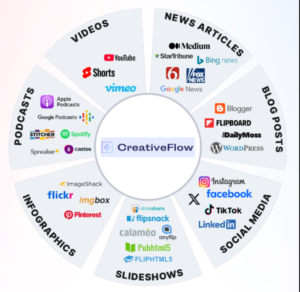
CreativeFlow’s multicasting system automates content distribution so your brand shows up wherever your audience searches – on Google, YouTube, podcasts, social media, and more.
Most brands publish to one or two channels and wonder why growth stalls. Multicasting closes that gap.
If your content lives on one platform, most of your audience will never see it.
Multicasting fixes that. Create content once, then distribute it across multiple platforms at the same time: Google, YouTube, social media, podcast directories, news sites, and more. The result is a growing web of branded content that search engines reward with higher authority signals. CreativeFlow built its entire system around this concept, making it practical for brands of any size to get measurable organic growth without doubling their workload.
Key Takeaways: Why Multicasting Drives Organic Growth
- Publishing to a single platform caps your reach and leaves branded search potential unused.
- Multicasting creates multiple indexed touchpoints, strengthening authority signals across search engines.
- Automated distribution removes the manual bottleneck from multi-platform publishing.
- Brands using consistent multicasting see stronger branded search volume over time, one of the highest-value SEO signals available.
What Multicasting Actually Means
Multicasting means distributing the same core content, or smart variations of it, across multiple platforms in one coordinated push. This is not about spamming identical posts everywhere. Done right, your brand’s message reaches audiences on the platforms they already use, in formats those platforms prefer.
The mechanics are simple. You create a piece of content: an article, a video, a podcast episode, or a press release. Instead of posting it in one place and hoping for traction, you distribute it across a network of platforms at once. Each published piece becomes an indexed digital asset. Stack enough of those assets together and you build something search engines genuinely respond to: consistent, authoritative brand presence across the web.
A blog post on your website competes against millions of other blog posts. That same content, distributed across YouTube, news aggregators, podcast directories, social platforms, and Web 2.0 properties, creates dozens of separate ranking opportunities, all pointing back to your brand.
Branded Search: The Biggest Untapped SEO Lever
Branded search, when someone types your company name directly into Google, is one of the strongest trust signals a search engine can receive. It tells Google that real people are actively looking for you, which reinforces your authority across all your rankings. Most businesses wait for branded search to happen on its own rather than engineering it on purpose.
Why Brand Reputation Is Now a Core Ranking Signal
Google’s algorithm has moved well beyond keyword matching. Today, it evaluates your brand’s overall presence across the web: how often your name appears, how many authoritative platforms reference you, and whether real users search for you by name. Multicasting feeds all three of these signals directly.
When your content appears on high-authority platforms like YouTube, Medium, news syndication networks, and podcast directories, Google picks up those references and begins associating your brand with topical authority. Over time, this builds what SEOs call entity authority: the idea that your brand is a recognized, trusted source on specific subjects.
Key Insight: Every new platform where your content lives is another opportunity for Google to verify that your brand is real, active, and authoritative. Multicasting accelerates this verification dramatically compared to single-platform publishing.
How to Build Branded Search Demand on Purpose
Building branded search demand requires putting your brand name in front of people consistently, across the channels they already visit. Multicasting handles the distribution side automatically. Here’s what that looks like in practice:
- Publish content to video platforms so users find your brand through search and suggested content.
- Distribute articles to news directories and Web 2.0 platforms to generate indexed backlinks and brand mentions.
- Syndicate podcast-style audio content to Spotify and Apple Podcasts, where search behavior is growing fast.
- Keep naming and messaging consistent across every platform so Google’s entity recognition systems connect all the dots.
Search Everywhere Optimization Is the New SEO Standard
Google is still dominant, but people now search on TikTok, YouTube, Reddit, Amazon, Pinterest, and LinkedIn too. Each of these platforms has its own algorithm, ranking system, and user intent patterns. If your content only lives on Google, a massive portion of your potential audience will never find you.
Search Everywhere Optimization means building a content presence across all the platforms your audience uses, not just traditional search engines. Multicasting makes this scalable. Without a distribution system, staying active across eight to twelve platforms would require a full content team. With multicasting, one piece of content does the heavy lifting across all of them.
What Platforms Now Count as Search Engines
The definition of a search engine has expanded. Someone wanting to fix a leaking pipe might search YouTube before opening Google. Someone looking for honest product reviews heads to Reddit. Someone after visual inspiration goes to Pinterest first. Each of these platforms indexes content, ranks it by relevance, and serves it to users with specific intent.
| Platform | Primary Search Use | Best Content Format |
|---|---|---|
| YouTube | How-to, tutorials, product reviews | Video (short and long form) |
| Honest opinions, comparisons | Conversational posts, threads | |
| Visual inspiration, DIY ideas | Infographics, image-led content | |
| B2B solutions, industry insights | Articles, thought leadership posts | |
| TikTok | Quick answers, trending topics | Short-form vertical video |
| Podcasting Platforms | In-depth topic deep-dives | Audio episodes, interviews |
A solid multicasting system targets as many of these platforms as possible from a single content creation effort. The goal is to establish brand presence everywhere your audience already searches so they find you naturally.
How Visual Search and Google Lens Fit Into Your 2026 SEO Strategy
Google Lens processes billions of visual searches every month, and that number keeps climbing. Users point their cameras at products, logos, and text to pull up search results. Your brand’s visual assets – thumbnails, infographics, branded images – now carry real SEO value when they’re indexed across multiple platforms. Multicasting content with optimized visuals increases the number of touchpoints available for visual search to surface your brand.
How to Prioritize Platforms Without Overextending
The biggest fear most marketers have about multi-platform distribution is the workload. That fear makes sense when everything is manual. Multicasting solves this by automating the distribution layer: you focus on creating quality content, and the system handles delivery.
Prioritization still matters. Start with platforms that index quickly and carry high domain authority. News syndication networks, YouTube, and established Web 2.0 platforms like Medium create fast, indexable links that Google finds within days. Social platforms support engagement signals. Podcast directories build long-tail presence. Layer these strategically and your multicasting footprint compounds over time.
YouTube Is Now a Core SEO Channel
YouTube is the second largest search engine in the world, and Google owns it. YouTube content gets preferential treatment in traditional search results. Ignoring YouTube in your distribution strategy in 2026 is a competitive disadvantage.
How YouTube Videos Appear in Google Search Results
Google regularly pulls YouTube videos directly into its results pages, especially for how-to queries, product comparisons, and instructional content. These video carousels appear above or alongside traditional text results. A well-optimized YouTube video can capture clicks that a text article never could, even if that article ranks on page one.
Example: A user searching “how to set up a Google Business Profile” will almost always see a YouTube video result in the top five positions, often before any written guide. Brands that distribute video through multicasting pipelines capture this visibility automatically.
YouTube videos rank on Google too. Every video your brand publishes becomes a dual-platform asset, indexed by both search engines at once. Factor multicasting into this: a single video distributed across YouTube plus supporting blog posts, social clips, and podcast audio creates a content cluster that dominates multiple search result formats.
Query Types Where Video Outranks Text
Video wins in specific categories. Tutorial and how-to queries almost always surface video. Product review searches heavily favor video results. Local business queries increasingly show video content, especially since Google began adding more multimedia to local packs. Create video content targeting these query types as part of your multicasting strategy to capture high-intent traffic that text content can’t reach.
How to Build a Long-Term Content Strategy That Survives Algorithm Shifts
Algorithm updates come and go. Brands with deep, multi-platform content presence consistently weather them better than single-channel publishers. The reason is simple: when your content lives across dozens of indexed platforms, a single algorithm change can’t erase your entire presence overnight. Multicasting builds resilience into your strategy from day one.
Build Content Clusters Around Core Topics
A content cluster is a group of related pieces that all point back to a central pillar topic. If your brand is in home renovation, your pillar might be “kitchen remodeling” with supporting content covering costs, timelines, materials, contractor selection, and before-and-after transformations. When you multicast an entire cluster, you build topical authority that signals deep expertise to search engines.
Each piece in the cluster gets distributed to multiple platforms at once, creating a web of interlinked content. Google sees consistent brand mentions, topic associations, and cross-platform references, all reinforcing your authority on the subject far more powerfully than a single well-written article could.
Refresh Existing Content Before Creating New Pages
One of the most overlooked content strategies is updating existing assets rather than always chasing new ones. Refresh a piece of content – update statistics, improve examples, expand sections – then redistribute it through your multicasting pipeline. You get renewed indexing activity and fresh platform placements without starting from scratch. This stretches your content investment further and signals to search engines that your brand actively maintains its information.
Embed Real Human Expertise Into Every Piece
Google’s Helpful Content system actively rewards content that demonstrates first-hand experience and genuine expertise. Your content needs more than accurate information; it needs perspective, specific detail, and real-world context. Multicasting amplifies quality content, which means the quality has to be there first. When both elements combine, genuine expertise plus wide distribution, the results compound faster than either strategy achieves alone.
Diversify Content Formats Across Platforms
Different platforms reward different formats. YouTube wants video. Podcast directories want audio. News networks want articles. Pinterest wants vertical images. A strong multicasting strategy accounts for this by adapting the core message into the format each platform prefers. You’re creating one core idea expressed in the language each platform speaks. That’s what separates smart multicasting from basic cross-posting.
The SEO Fundamentals That Haven’t Changed Since 2019
Despite every algorithm update, core SEO principles remain constant. Content still needs to match search intent clearly. Pages still need fast load times, clean mobile experiences, and logical internal linking. Backlinks from authoritative sources still carry weight. Title tags and meta descriptions still influence click-through rates. These fundamentals are the floor; multicasting and branded search strategies are what you build on top to reach the ceiling faster.
What multicasting adds is velocity and scale. Instead of earning one backlink at a time through manual outreach, distribution across high-authority platforms generates multiple indexed references at once. Instead of slowly building brand mentions, every multicasting campaign creates a fresh wave of them. The fundamentals create the foundation. Multicasting accelerates everything built on it.
Frequently Asked Questions
What is multicasting in content marketing?
Multicasting is the process of creating content once and distributing it across multiple online platforms at the same time. Instead of publishing a blog post to one website and waiting, multicasting pushes that content, or format-adapted versions of it, to YouTube, news directories, podcast platforms, social networks, and Web 2.0 properties simultaneously. Each published instance becomes an indexed digital asset that contributes to your brand’s overall search visibility.
How does multicasting improve organic search results?
Every platform where your content appears creates a new indexed touchpoint for search engines to associate with your brand. When Google sees consistent, authoritative content about your brand across dozens of high-quality platforms, it reads this as a strong trust signal. More indexed references mean more ranking opportunities, more branded search triggers, and stronger entity authority, all of which translate directly into improved organic search performance over time.
Is multicasting the same as content syndication?
They overlap but aren’t identical. Content syndication typically means republishing full articles on third-party websites, sometimes with canonical tags pointing back to the original. Multicasting is broader: it includes syndication and also covers video distribution, audio publishing, social broadcasting, and news network placement. Multicasting treats every platform as a valid distribution channel, not just article directories.
The key difference is intent and scale. Syndication is usually about SEO link equity. Multicasting is about building total brand presence across every platform where your audience searches, which ultimately drives stronger branded search demand, more organic growth, and a more resilient content footprint than syndication alone.
How many platforms should I distribute content to?
The more high-authority platforms your content reaches, the stronger your brand’s indexed presence becomes. Quality of platforms matters more than raw quantity. Prioritize platforms that index quickly, carry high domain authority, and align with how your audience actually searches. A well-executed multicasting strategy targeting fifteen to twenty quality platforms will consistently outperform one that blasts content to fifty low-quality directories.
Can small businesses benefit from multicasting?
Yes, and multicasting often delivers a disproportionate advantage to smaller brands. Large enterprises already have massive domain authority and brand recognition. For a smaller brand, multicasting creates the kind of wide platform presence that takes bigger competitors years to build organically. By consistently distributing quality content across multiple channels from the start, smaller businesses can build branded search demand and topical authority faster than traditional SEO methods allow.