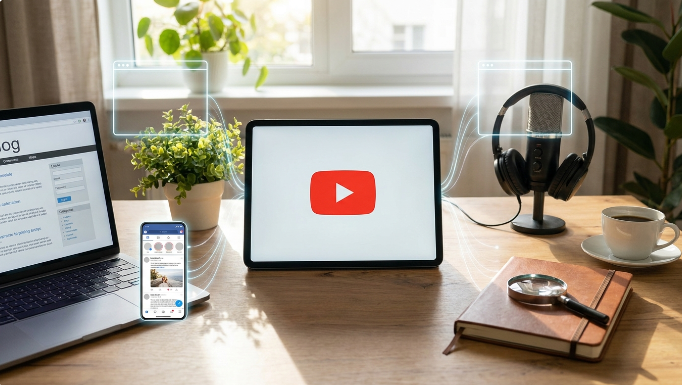
In 2026, ranking blue links on Google is table stakes. The brands pulling ahead right now create content once and broadcast it across dozens of platforms and formats. This strategy, multicasting, puts your brand in front of buyers wherever they search: YouTube, Reddit, TikTok, AI tools like ChatGPT, and Google itself.
93% of buyers research across multiple platforms before they purchase. A single-format strategy can’t keep up. Today’s searcher wants to see your answer, hear it, and verify it across different surfaces. YouTube anchors this shift, creating a “4-surface effect” that crowds out competitors in organic results.
Quick Takeaways
- The 4-Surface Win: One video can rank in YouTube search, Google Video carousels, AI Overviews, and boost your blog post authority – all at the same time.
- Transcript Power: Google indexes spoken keywords from video transcripts. This turns your video script into on-page SEO for high-intent queries.
- Intent Shift: Video now permanently outranks text for “how-to” searches, product comparisons, and experiential reviews.
- Brand Signal: Multicasting builds branded search demand, a core ranking signal for both AI and traditional algorithms.
The 4-Surface Win: How YouTube Anchors Your Visibility
When you use YouTube as your multicasting anchor, you claim real estate on four distinct surfaces within organic search results. This compounding effect is why multicasting delivers a higher ROI than text-only SEO.
1. YouTube Native Search
YouTube is the second-largest search engine in the world. Optimize your video for YouTube’s internal algorithm and you capture audience intent at the top of the funnel. This is where research begins, especially for younger audiences who prefer visual answers over long articles.
2. Google Video Carousels
Google’s main results page frequently features video carousels for informational and transactional queries. A well-optimized video can leapfrog traditional blue links, appearing at the very top of the page. Your brand occupies two spots on the same results page: one for your website, one for your video.
3. AI Overview Snippets
Google’s AI Overviews increasingly cite video content. When written content on a topic is thin or lacks real-world depth, AI systems pull directly from video transcripts. Being the cited source in an AI-generated response builds immediate authority and drives high-intent traffic.
4. Blog Post Dwell Time and Authority
Embedding your YouTube video into a relevant blog post creates a content cluster effect. It signals topical relevance to Google and increases average time on page. When users stay longer to watch a video, Google reads your page as helpful, which boosts your written content’s rankings too.
Video Transcripts: The New On-Page SEO
Technical SEO used to mean sitemaps and schema markup. Those still matter. Google now indexes YouTube video transcripts automatically. The words you speak in your video function like H2s and body text on a blog post.
Structure your script to answer specific questions with natural language and clear keyword intent. You’re performing on-page SEO inside a video format.
To get the most from this:
- State the problem clearly
- Provide a step-by-step solution
- Use descriptive, specific language
When Google’s bots crawl your transcript, they find semantically related terms that reinforce your topical authority. Treat your video script with the same keyword discipline you’d apply to a pillar page.
When Video Outranks Text: High-Impact Query Types
Not all search queries are equal. In 2026, specific categories see video content replace text as the primary result.
Tutorials and “How-To” Processes
Any query involving a physical demonstration or software walkthrough favors video. Someone searching “how to set up a content cluster” would rather watch a 3-minute video than read a 2,000-word guide. Google’s data shows video results capture a disproportionate click share for demonstration queries.
Product Comparisons and Reviews
Trust drives purchase decisions. In the consideration phase, buyers look for human signals. Seeing a real person hold a product, test its features, and give an honest opinion delivers authenticity that text alone can’t match. “Best of” and “Product X vs Product Y” searches are now dominated by video carousels and AI-cited video reviews.
Experiential and Opinion-Based Searches
Queries like “Is [Service] worth it?” or “My experience with [Topic]” favor first-person video. Google’s E-E-A-T guidelines prioritize content showing real-world experience. A transcript that includes “In my experience” or “When I tested this” provides the expertise signals algorithms reward.
From Keyword Targeting to Entity Multicasting
The old SEO playbook chased individual keywords. The new playbook builds an entity: a brand recognized as an authority across the entire web. Multicasting drives this.
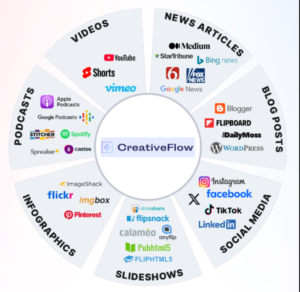
Distribute content in multiple formats (news articles, social posts, reels, podcasts, flipbooks) across 300+ platforms. You create a “surround sound” effect for your brand. Beyond driving traffic, this builds branded search demand. When people start searching your brand name specifically, it sends the strongest possible trust signal to Google and AI platforms. A strong brand reputation protects you from algorithm volatility.
A single piece of high-quality research transforms into:
- A long-form video for YouTube
- A series of short-form Reels or TikToks for social channels
- An interview podcast for Spotify and Apple Podcasts
- A detailed blog post for your website
- A press release for Google News visibility
- Infographics for visual search and Pinterest
Every piece serves a purpose: covering every surface where your audience searches.
Practical Framework: Start Multicasting Today
You don’t need to overhaul everything at once. Start by auditing your existing high-performing content and applying a repurposing framework.
Step 1: Identify Your Anchor Topics
Check your Google Search Console data. Which pages rank in positions 4-15? These have authority but need a multicasting boost to reach the top. These topics become your anchors.
Step 2: Create the Video Anchor
Produce a high-quality video for each anchor topic. Answer the primary search intent within the first 60 seconds. Keep your transcript clear and keyword-rich. Upload to YouTube with an optimized title and description that links back to your blog post.
Step 3: Distribute and Fragment
Pull the core insights from your video and turn them into 3-5 short-form clips. Generate a transcript-based blog post or update your existing one with the video embed. Share insights as a LinkedIn carousel and a thread on X.
Step 4: Monitor Branded Search
As your presence grows across platforms, track branded search volume. Are more people searching “[Your Brand] + [Topic]”? This is the ultimate metric for multicasting success. It proves your audience now associates your brand with the solution they need.
Frequently Asked Questions
Is traditional SEO dead?
No. Keywords, backlinks, and technical health still matter. SEO has expanded into multicasting. Traditional SEO is now one component of a broader strategy that includes video, social search, and AI optimization.
Does AI search reduce website traffic?
AI Overviews can reduce click-through rates for simple factual queries. For complex queries requiring depth and expertise, AI search actually pre-qualifies traffic. Users who click through from an AI citation are often further down the funnel and more ready to convert.
Why is YouTube so important for SEO in 2026?
YouTube is the only platform that hits four search surfaces at once: its own search engine, Google Video carousels, AI Overview citations, and on-page dwell time for your website. It’s the most efficient way to build topical authority.
Can I use AI to write my content?
Use AI for research and outlining. The final output must contain human expertise. Google’s helpful content systems identify and downrank generic, AI-only content. Multicasting works best when it amplifies genuine, original insights.
The Future of Search Is Everywhere
The brands winning in 2026 stopped viewing Google as their only channel. Multicasting builds a resilient digital presence that survives algorithm shifts and AI disruptions. YouTube as your anchor lets you dominate organic results across multiple surfaces, building the trust and authority needed for long-term growth.
Your next step: take your best-performing article and turn it into a video. Start the multicasting cycle and watch your visibility grow far beyond traditional blue links.
See how we can help at FredetteCreativeMedia.info