
SEO has become multicasting: a strategy built around appearing on every surface where your audience does research. AI Overviews. ChatGPT. Reddit threads. YouTube. If you’ve spent years chasing backlinks, here’s what changed: AI platforms now judge authority through a much broader lens of human expertise and brand mentions.
Quick Takeaways
- Traditional SEO is no longer a single-channel game. It has expanded into a multi-platform system.
- AI platforms like Perplexity and ChatGPT prioritize brands mentioned on high-trust forums like Reddit, G2, and industry news sites.
- Content must shift from generic information to unique judgment and first-hand experience to earn AI citations.
- Multicasting means repurposing expert content into multiple formats (video, audio, news) to fuel a self-reinforcing growth cycle in modern search.
Why Traditional SEO Is Becoming Multicasting
For decades, the SEO playbook was simple: find a keyword, write a post, build backlinks. Those fundamentals still exist. They are no longer enough to stay visible in 2026. Searchers have changed their behavior. 93% of people now research across multiple platforms, including YouTube, TikTok, podcasts, and AI tools, before making a purchase decision.
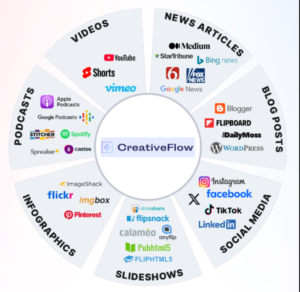
If your strategy is limited to ranking a single page on Google, you are missing 73% of the modern search ecosystem. SEO has become multicasting because brands must distribute their expertise across 300+ platforms to stay relevant. Creating a consistent footprint lets AI systems and search engines verify your brand’s authority. When you show up in news articles, podcasts, and social feeds at the same time, you create a “megaphone effect” that signals to Google and AI models: this business is a trusted entity.
The Decline of Commodity Content
AI Overviews and large language models (LLMs) are exceptionally good at answering simple, factual questions. If your content merely summarizes common knowledge, an AI will absorb that information and present it to the user without ever sending them to your website. Multicasting fights this by focusing on high-value, non-commodity insights that require human expertise: the kind of content AI platforms feel compelled to cite rather than summarize.
How AI Platforms Evaluate Brand Authority Beyond Backlinks
In the legacy SEO era, a backlink from an authoritative site was the primary vote of confidence. Today, AI platforms evaluate authority through a complex web of brand mentions and “entity relationships.” They aren’t looking at who links to you. They’re looking at who talks about you and in what context.
AI systems like Perplexity, Claude, and Google’s Gemini prioritize sources that demonstrate real-world engagement. Your presence on third-party validation platforms is now a core ranking signal. If real people discuss your product on Reddit or review your services on G2 and Trustpilot, AI models read this as a high-trust signal, one far harder to manipulate than a traditional backlink.
The Role of Reddit and Community Forums
Reddit has become a primary source for AI training and real-time search results. Forum users share raw, unvarnished experiences. AI systems lean heavily on these discussions to provide “experiential” answers. To win the AI citation game, brands must move beyond their own domains and make sure their expertise shows up in these community-driven spaces. This is a key part of multicasting: your brand’s story must exist where the conversations actually happen.
Industry News and Authority Mentions
Being cited in industry-specific news sites or Google News gives a level of time-sensitive authority that static blog posts can’t match. Multicasting your expertise through press releases and news articles ties your brand to current, trending topics. AI models use these signals to determine which entities currently lead their fields.
The Shift from Information to Judgment and Experience
To earn organic search results that drive real business value, content must move past “what” and focus on “how” and “why.” AI can explain what a content cluster is. It cannot share the specific lessons learned from managing a medical device company’s 20,000% traffic increase. That is the experience gap.
Google’s E-E-A-T (Experience, Expertise, Authoritativeness, Trustworthiness) guidelines have become the blueprint for survival. Content cited by AI in 2026 is almost always built on one of the following:
- First-Person Case Studies: Real data, specific numbers, documented outcomes.
- Contrarian Insights: Perspectives that challenge the industry status quo, grounded in professional experience.
- Nuanced Judgment: Decision-making frameworks that help users choose between complex options, something AI still struggles to do without human-authored source material.
Why AI Cites Experience
AI platforms are designed to minimize hallucinations. They look for “grounding” sources: content that provides evidence of real-world activity. When you multicast your expertise through video demonstrations on YouTube or in-depth interviews on podcasts, you provide multiple formats of proof that your brand is a legitimate expert. This makes your site the safest choice for an AI to cite.
Structuring Content for AI-Readability and Entity Clarity
The quality of your insight matters most. The technical structure of your content determines whether an AI can easily extract and credit that insight. Structuring for “AI-readability” is a core tactic in the multicasting era. Move away from long, rambling essays and toward modular, answer-ready formats.
The Q&A Framework
AI models are trained to find answers to specific user prompts. Structure sections of your content as direct questions followed by concise, expert answers. This increases the likelihood of being featured in AI Overviews and featured snippets. Go beyond FAQ sections. Make your entire page a series of clear, authoritative responses to the questions your buyers actually ask.
Establishing Entity Relationships
Your content should clearly define the relationships between your brand (the entity), your products, and the problems you solve. Structured data and clear semantic headers help search engines understand that your brand is the authoritative source for a specific niche. In multicasting terms, use the same terminology and entity definitions across your blog, YouTube descriptions, and podcast metadata. This creates a unified brand signal.
Implementing the Multicasting Workflow
Moving from traditional SEO to a multicasting strategy requires a change in production. Instead of writing one blog post and moving on, treat every piece of expert insight as a “source asset” you can optimize for different platforms.
The Eight Formats
Effective multicasting takes one core idea and transforms it into multiple formats to capture different search intents:
- News Articles: For immediate authority and Google News visibility.
- Social Posts: To drive engagement and brand mentions on LinkedIn, X, and Facebook.
- Short-Form Video (Reels/TikTok): For reaching younger demographics and mobile search.
- Infographics: To capture visual search intent and Pinterest traffic.
- Podcasts: To build audio authority and appear in Spotify/Apple searches.
- Slideshows/Flipbooks: For document-sharing sites like SlideShare.
- Long-Form Video: To rank on YouTube, the world’s second-largest search engine.
- SEO Blog Posts: To serve as the central hub for organic search results.
Distribute these formats across 300+ platforms and you create a self-feeding growth cycle. Traffic from social media and video platforms feeds back into your website, increasing your branded search volume: one of the most powerful ranking signals in 2026.
Frequently Asked Questions
Does multicasting mean I should stop focusing on my website?
No. Your website remains your home base and the primary destination for high-intent traffic. Multicasting expands the number of paths that lead to your site. Showing up on YouTube, AI platforms, and news sites builds the authority that helps your website rank higher in traditional organic search results.
How do I know if my content is being cited by AI?
Track AI citations by monitoring “referral traffic” from AI search engines like Perplexity and ChatGPT in your analytics. You can also use branded search volume in Google Search Console as a proxy. As your brand gets cited more frequently across the web, more users search for your brand name directly.
Is AI-generated content okay for a multicasting strategy?
AI can help with repurposing content (turning a blog post into a social thread, for example). The core “source asset” must be grounded in human expertise. If the initial input is generic AI text, the resulting multicast content will lack the “Human Expertise Signals” required to earn high-value citations and trust.
What Comes Next
The era of gaming the system with thin content and purchased backlinks is over. SEO has become multicasting, and the winners will be those who prioritize brand reputation and multi-platform visibility. Focus on human judgment. Structure content for AI-readability. Show up wherever your audience searches. Do this and AI becomes your greatest competitive advantage.
Your next step: audit your current content. Does it offer the kind of expert judgment AI platforms need to cite? Start by turning your most successful case study into a multi-format campaign and watch how multicasting transforms your results.