
Your law firm ranks on Google, but potential clients are watching your competitor’s YouTube videos, asking ChatGPT for recommendations, and following other attorneys on LinkedIn. Here’s why organic search traffic dropped 8% while AI referral traffic surged 592% in 2024.
Key Takeaways
- Potential clients use more than one platform to research law firms before making a hiring decision – Google alone is not enough.
- Video, social media, AI tools, and podcasts are now active parts of the client research journey, and firms invisible on these channels are quietly losing cases to competitors.
- A multi-channel content strategy compounds over time, delivering far greater long-term ROI than paid ads alone.
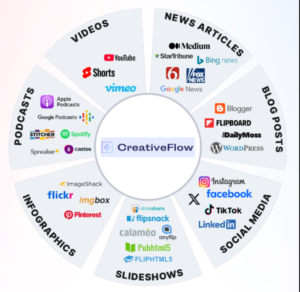
- Fredette Creative Media’s partner platform, Creative Flow, distributes content across 300+ platforms in 8 formats – answering the exact questions potential clients are asking across every channel.
- The firms winning new business in 2025 are not just ranking on Google – they are showing up everywhere their clients look.
Most law firms pour their marketing budget into Google and call it a day. That approach used to work. Today, it leaves a significant portion of potential clients – the ones scrolling YouTube, asking ChatGPT, listening to podcasts, or browsing LinkedIn – completely untouched. Understanding how modern legal clients actually research their options is the first step toward building a marketing strategy that converts.
Most Client Research Happens Away From Google
Google holds roughly 90% of the global search market, yet search activity is spread across dozens of platforms – YouTube, TikTok, Instagram, LinkedIn, Amazon, and increasingly AI tools like ChatGPT and Perplexity. A significant share of potential clients use more than one platform before choosing a law firm, which means the gap between started on Google and decided based on Google alone is where most law firm marketing budgets quietly bleed out.
The client who finds a firm on Google but then watches a competitor’s YouTube explainer, hears a competing attorney on a podcast, and sees a competitor’s LinkedIn posts – that client is gone before the first consultation request ever arrives.
How Clients Actually Research Law Firms
The Multi-Platform Research Journey
Modern legal consumers do not just search – they investigate. A potential personal injury client might start with a Google search, watch two or three YouTube videos about what to expect after a car accident, browse Reddit threads for real experiences, check a firm’s Instagram for social proof, and finally ask ChatGPT to summarize their options. Each of those touchpoints is an opportunity to build trust – or an opportunity missed entirely.
This behavior is driven by the high stakes of hiring an attorney. People are not buying a product they can return. They are choosing someone to represent them through some of the most difficult moments of their lives. That decision takes time, multiple sources, and repeated exposure to a firm’s voice, credibility, and expertise.
What Happens When a Firm Is Invisible on Other Channels
Invisibility on non-Google platforms does not just mean missing clicks – it means actively ceding ground to competitors who show up during those critical research moments. When a potential client searches for a divorce lawyer and finds Firm A on Google, but then watches Firm B’s YouTube video explaining the divorce process in plain English, Firm B has built significantly more trust without spending a dollar on ads. That is the compounding power of multi-channel presence, and it works whether a firm is intentionally building it or not.
Video and Social: Where Decisions Get Made
Video as a Driver of New Legal Business
Video has moved from a nice-to-have to a legitimate driver of new case volume. Attorney explainer videos and client testimonials do something written content struggles to replicate – they let a potential client hear the attorney’s voice, see their demeanor, and decide whether they feel comfortable before ever picking up the phone. That pre-qualification improves both the quality and likelihood of consultation bookings.
Video content also performs across multiple platforms simultaneously. A single recorded explainer can appear on YouTube, be clipped into short-form content for Instagram Reels or TikTok, and be repurposed into a podcast episode – extending its reach well beyond a single channel.
Most Law Firms Use Social Media Ineffectively
Social media is part of the marketing strategy at the majority of law firms, and many attorneys report that their social presence has directly or indirectly generated new business. Yet being on social media and using it effectively are very different things.
Most law firms post sporadically – a firm anniversary announcement here, a generic legal tip there – without a content strategy tied to the questions actual clients are asking. The firms generating consistent social leads publish educational content that answers real legal questions, positioning attorneys as trusted advisors rather than service providers. That distinction matters enormously to people researching high-stakes legal decisions.
AI and Podcasts Are Sending Clients to Competitors
AI Referral Traffic Has Surged Year-Over-Year
Here is a data point that should get every law firm’s attention: organic search traffic for law firms dropped an average of 8% in the first three quarters of 2024, while traffic originating from AI sources surged by 592.90% during the same period. That is not a rounding error – it is a structural shift in how people find information.
AI tools like ChatGPT, Perplexity, and Claude are now being used to answer legal questions directly. When someone asks an AI what to look for in a personal injury attorney, the AI pulls from published content across the web. Firms with content answering those questions – on blogs, news sites, YouTube, and other indexed platforms – get recommended. Firms without that content simply do not appear. The adoption of AI tools by legal professionals has also surged, from 19% in 2023 to 79% in 2024, and firms using AI-powered marketing tools are seeing meaningful increases in lead conversion rates.
Podcasts That Build Thought Leadership and Leads
Podcasting offers something most marketing channels cannot: sustained, undivided attention. A listener who follows an attorney’s podcast through a 20-minute episode on estate planning has developed a level of familiarity and trust that no banner ad can replicate. Research suggests that integrating podcasts into a brand’s media mix can increase overall campaign effectiveness by 21% to 40%, and nearly half of weekly podcast listeners have taken action after hearing about a service on a podcast.
Beyond direct lead generation, podcast content is highly repurposable. A single recorded episode can be transcribed into a blog post, clipped into social media shorts, converted into an infographic, and distributed across podcast directories – compounding its reach across multiple platforms simultaneously. Creative Flow by Fredette Creative Media takes exactly this approach, turning one core content campaign into 8 formats distributed across 300+ platforms, so law firms show up wherever their clients are looking.
The Multi-Channel Content Engine Explained
Multiple Formats, Hundreds of Platforms, One Unified Campaign
A true multi-channel strategy is not about posting the same thing everywhere – it is about meeting clients in the format and platform native to where they are already searching. That means long-form video for YouTube, short-form clips for TikTok and Instagram Reels, audio for Spotify and Apple Podcasts, infographics for Pinterest and visual search, blog posts for SEO, news articles for authority and AI indexing, and social posts for engagement and referral traffic.
Each format serves a different moment in the client research journey. A potential client might find a firm through a YouTube Short, deepen their trust through a full explainer video, confirm the firm’s credibility through a news article, and finally call after seeing a testimonial on Facebook. No single format closes the loop alone – but together, they create a presence that is hard to ignore.
The Compound Growth Effect Over Time
Unlike paid advertising – which delivers traffic only as long as the budget flows – content-based multi-channel marketing builds permanent online assets. Each published piece continues to drive traffic, generate AI citations, and rank in search long after it is posted. Over time, this creates a compound growth curve: more content means more touchpoints, more touchpoints mean more trust, and more trust means more consultations.
Organic vs. Paid: The Long-Term Math
Law firms spend heavily on Google Ads and Local Service Ads, and those channels have their place – especially for high-intent, bottom-of-funnel traffic. But the economics of paid-only strategies are increasingly difficult to justify. Ad costs in competitive legal markets have risen sharply, click-through rates are eroding as users develop ad blindness, and platform algorithm changes can destabilize performance overnight.
Organic content does not stop working when the budget pauses. A well-optimized blog post answering how long a personal injury settlement takes can generate qualified traffic for years. A YouTube video explaining workers’ compensation rights can be found by new searchers every single day. The investment is front-loaded; the returns are ongoing. For firms looking to reduce cost-per-acquisition and build sustainable lead pipelines, content-led growth layered on top of – not replacing – strategic paid spend is a strong long-term position.
Be Everywhere Your Clients Search – or Lose Them to Firms That Are
The legal market has always been competitive. What has changed is where that competition plays out. Winning a top Google ranking no longer guarantees client acquisition when a large share of prospects are also researching on video platforms, social networks, AI tools, and podcasts before making their decision.
The firms pulling ahead in client acquisition right now are not necessarily the ones with the biggest ad budgets – they are the ones consistently showing up in every channel where their ideal clients are asking questions. Consistency and reach across platforms, not any single channel, is what drives sustainable growth.
Law firm marketing in 2025 requires a multi-channel presence because that is where client decisions are actually made. Google is the starting line, not the finish line. The firms that understand this – and act on it – will continue to outpace competitors who are still betting everything on a single channel in a multi-platform world.
Fredette Creative Media helps law firms and businesses build exactly this kind of online presence – learn more at fredettecreativemedia.info.
Also See
Stay Connected
Terms of Service | Privacy Policy
© 2026 Creative Flow. All rights reserved.