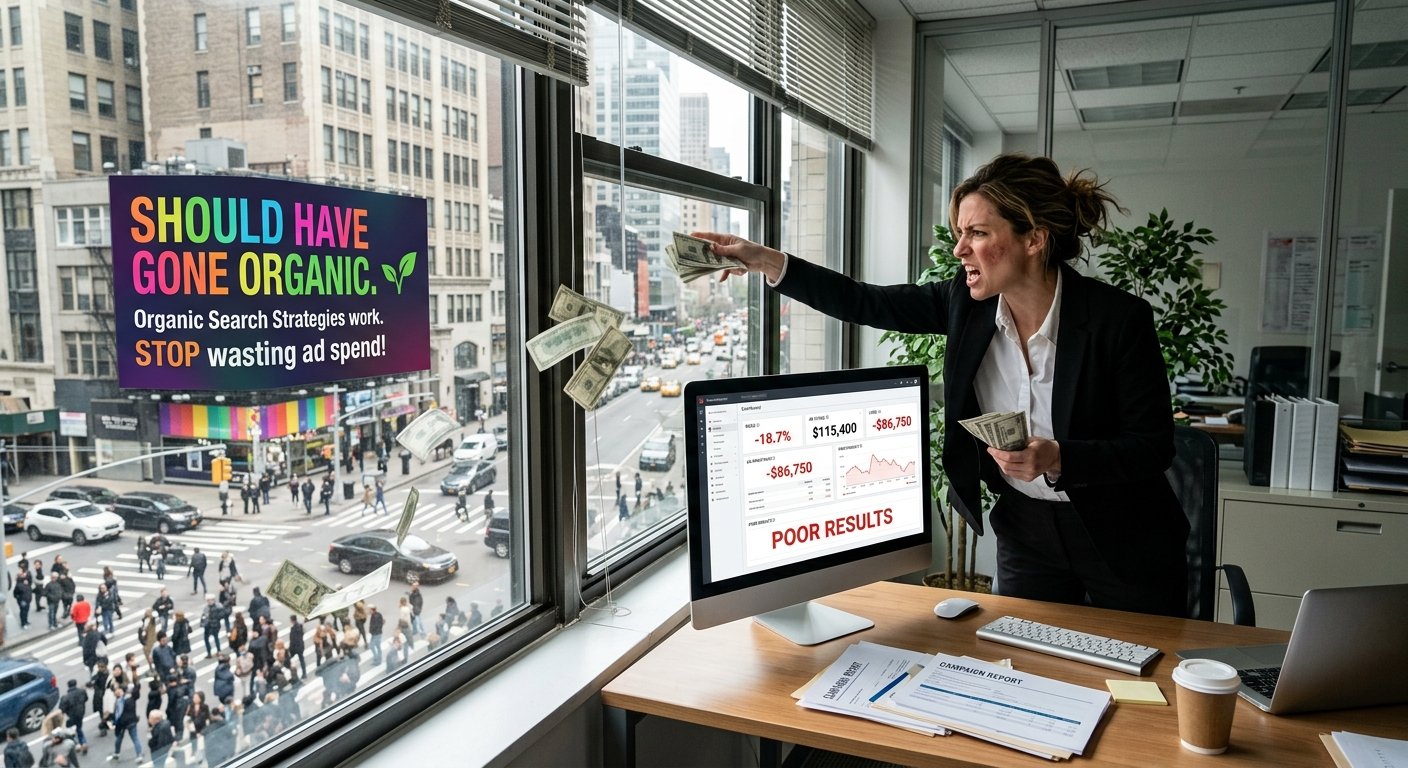

Most mid-market marketing teams waste entire quarters making one avoidable mistake: choosing paid search or organic at exactly the wrong time. When a $70+ cost-per-lead becomes unsustainable, or when SEO starts six months too late, the real problem isn’t execution.
Every quarter, marketing directors at mid-market companies face the same pressure: pipeline needs to grow, budgets are finite, and leadership wants to know which channel is working. The debate almost always defaults to paid search versus organic search – and almost always misses the real question.
Wrong Channel, Wasted Quarter
The most expensive search marketing mistake is not poor execution. It is picking the right tactic for the wrong moment. A business that needs leads this quarter invests in SEO alone and waits six months for results. Another company, tired of watching acquisition costs climb, keeps doubling down on paid ads without ever building organic equity. Both decisions feel logical in isolation. In context, they are budget drains.
This mismatch between channel and timing is exactly where mid-market growth stalls. Paid search and organic search solve different problems on different timelines. Forcing one to do the other’s job is where wasted quarters are born. Creative Flow frames this distinction around pipeline urgency and timing goals rather than platform preference – a far more useful lens for any VP of Growth facing a quarter-end shortfall.
The fix starts with understanding what each channel actually does – not in theory, but in practice.
What Each Channel Actually Does

Paid Search: Speed and Control
Paid search is built for immediacy. Ads can appear at the top of search results within hours of launching a campaign, making it the go-to for new product launches, seasonal pushes, or any situation where pipeline needs to move fast. Google processes over 13.7 billion searches per day, and paid placements put a brand directly in front of high-intent buyers at the exact moment they are looking.
The control is a major advantage. Targeting can be refined by keyword, location, device, demographics, and online behavior – ensuring spend is focused on the most relevant audience. But that control comes with a real cost. The average Google Ads cost per lead hit $70.11 in 2025 for B2B, with B2B leads typically running 2-4x more expensive than B2C. Visibility can start fast, but Google Ads campaigns typically need 7-10 days to exit their learning phase, with initial meaningful performance data emerging within 2-4 weeks – full optimization and stable, profitable results generally require 3-6 months. For full-funnel B2B attribution – connecting ad spend to closed deals – the window stretches to three to six months depending on sales cycle length.
Paid search captures existing demand effectively. Without continuous optimization, even well-targeted campaigns erode over time.
Organic Search: Authority and Compounding Returns
Organic search operates on a completely different clock. According to BrightEdge, organic accounts for over 50% of all website traffic – and unlike paid ads, that traffic does not stop when a budget runs out. Businesses that invest consistently in organic content can see substantial year-over-year traffic growth, with authority and rankings compounding over time.
The tradeoff is patience. Organic search is a long-term infrastructure play – one that builds credibility, reduces dependence on paid clicks, and creates durable visibility in markets where trust influences conversion. Users also tend to favor organic results over paid ads when researching high-consideration purchases, making SEO especially powerful for complex B2B buying cycles.
Pipeline Urgency Changes Everything
When You Need Leads This Quarter
If referrals have slowed, sales needs more opportunities now, and leadership wants results within 90 days – paid search is the stronger first move. It captures active buyer intent immediately and can be adjusted in real time based on what is converting. The key is pairing it with strong landing pages, clear conversion paths, and fast follow-up. Paid traffic into a weak system just accelerates spend without improving results.
When You Can Invest for Next Year
When the pipeline is stable but acquisition costs are climbing, organic search becomes the smarter long-term investment. The goal shifts from capturing demand immediately to building a system that generates qualified traffic without paying for every click. Content depth, commercial intent targeting, and technical SEO do their compounding work here – often delivering stronger returns over a 12-24 month horizon than any single paid campaign.
The Real Cost of Each Channel
What Paid Search Actually Costs at Scale
Paid search costs do not live in cost-per-click alone. A B2B paid search budget typically spans multiple platforms – Google, LinkedIn, Bing, and Meta – with each targeting different stages of the buyer’s journey. As campaigns scale, so does the complexity and management overhead. When acquisition costs rise and margins tighten, the model becomes harder to sustain without organic infrastructure underneath it.
Why Organic Is Not Free Either
Calling organic search free traffic is a common and misleading shortcut. Strong SEO requires ongoing investment in content strategy, technical site health, link building, and optimization. The difference is in the return structure: paid search is a linear exchange – spend stops, traffic stops. Organic search is a compounding asset. The investment made today continues paying returns months and years later, which is why the long-term cost-per-lead for mature SEO programs tends to be significantly lower than paid.
When a Blended Strategy Wins
For growth-stage companies facing pressure from both sides – needing leads now but knowing paid-only is unsustainable – the answer is sequencing, not choosing. Paid search handles immediate demand capture while organic search builds future efficiency. Together, they reduce the single-channel dependency that makes forecasting unpredictable.
Using Paid Data to Accelerate SEO
One of the most underused advantages of running both channels simultaneously is the keyword intelligence paid campaigns generate. PPC data reveals which terms drive actual conversions, not just clicks – giving SEO strategy a precise target list grounded in real buyer behavior rather than search volume estimates alone. This can meaningfully compress the time it takes organic content to gain traction on high-value terms.
A real-world example illustrates the combined impact: a CNC manufacturing company running Google and Meta ads converted over 500 leads and drove a $5M+ pipeline, while a parallel website redesign focused on organic optimization produced a 14,000% traffic surge. Neither result came from one channel alone.
KPIs That Reflect Real Growth
Traffic, rankings, and impressions are signals – not outcomes. For marketing directors and VPs of Growth accountable to revenue targets, the metrics that actually matter tell a different story:
- Qualified leads – not total form fills
- Cost per qualified lead and cost per sales opportunity
- Lead-to-opportunity rate and opportunity-to-close rate
- Return on ad spend (ROAS) for paid campaigns
- Non-branded organic traffic tied to commercial intent pages
- Pipeline contribution by channel – the metric that finally connects marketing performance to revenue
When reporting is built around these numbers, channel decisions become easier to defend – and easier to adjust when something is not working.
Match the Channel to the Moment
The question was never which channel is better in general. It is which channel is better right now, for this business, at this stage of growth. Paid search wins when speed and control are the priority. Organic search wins when durability and lower long-term acquisition costs are the goal. A blended approach wins when both timelines matter – which, for most mid-market companies with real growth targets, is most of the time.
The businesses that waste quarters are not usually running bad ads or writing bad content. They are using the right tools at the wrong time. Getting that sequencing right – and measuring what actually connects to revenue – is where search strategy stops being a debate and starts being a growth system.
Fredette Creative Media helps mid-market businesses build search strategies grounded in real pipeline goals – visit Fredettecreativemedia.info to see how they connect channel decisions to measurable growth outcomes.